
What Mason County Property Tax Records Show
Start with the Mason County PVA search. The qPublic tool opens the county's assessment roll, though its exact field labels are best confirmed on the live result screen. Payment questions belong elsewhere. The Sheriff answers current collection, while the Clerk takes bills that turned delinquent.
| Field | What It Shows | Where |
|---|---|---|
| Assessment | The value placed on the roll for a stated tax year | Mason County PVA |
| Property class | The classification affecting assessment treatment | Mason County PVA |
| Exemption | Relief applied when the owner and property qualify | PVA and Kentucky Revenue |
| Current bill | Amount, discount or penalty stage, and payment status | Mason County Sheriff |
| Delinquent certificate | Post-transfer tax claim and related status | Mason County Clerk |
An assessment is not a negotiated price. The PVA values the parcel for taxing. A tax bill then applies local rates and any qualifying relief to that taxable basis. A recorded deed, meanwhile, may show a separate consideration amount and date from a different transaction.
Kentucky's Annual Valuation Cycle Shapes Mason Assessments
Kentucky Revenue's assessment guide explains the statewide rule. Real property is revalued every year. Physical exams follow at least once every four years. PVAs may lean on sales comparison, cost, or income approaches as each parcel demands. That cycle is why a Mason assessment can shift without a new deed, and why two neighboring parcels rarely move by the same amount.
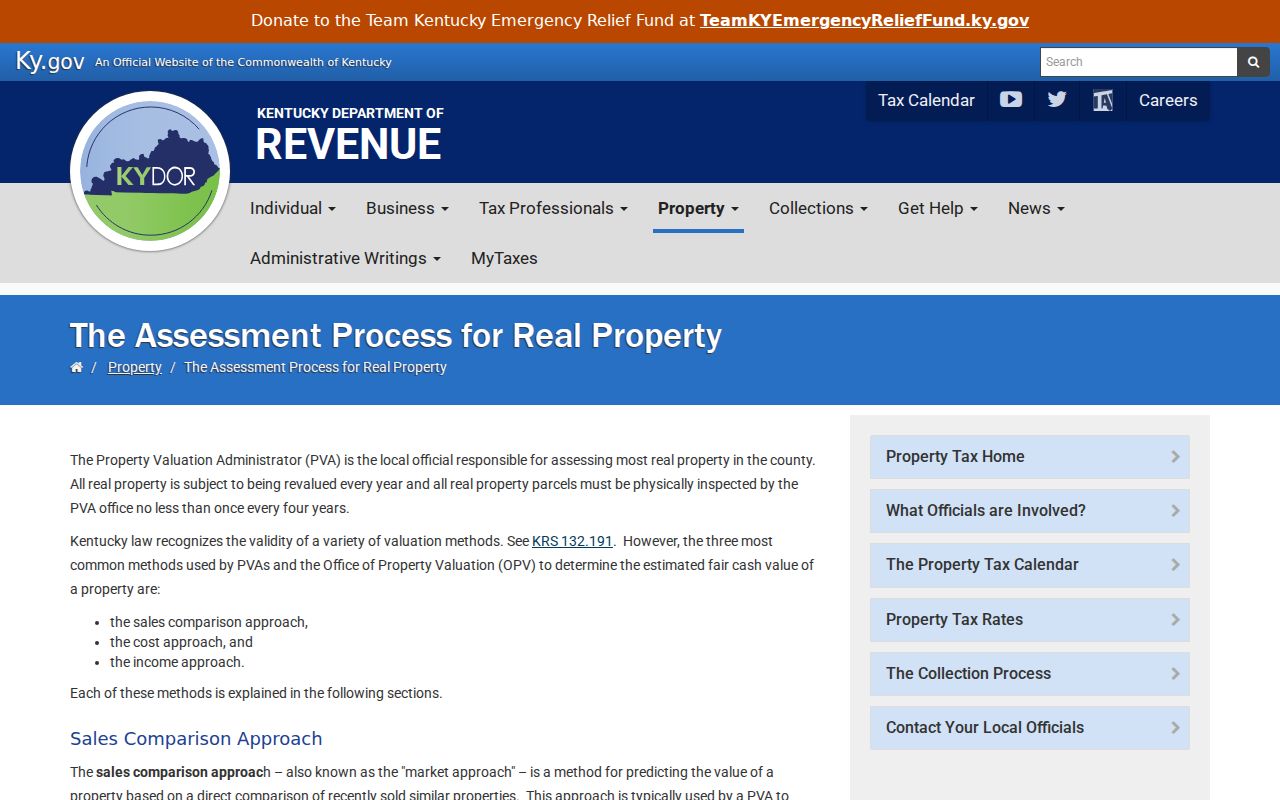
Use that page to grasp the statewide cycle. Then ask the Mason PVA which property data and valuation approach shaped the parcel you care about.
Search the Mason Assessment Roll With the Best Key
| Search key | Use | Check in the result |
|---|---|---|
| Address | Locate a known situs | Street spelling and mailing-address difference |
| Owner name | Find property under the displayed taxpayer | Initials, entities, trusts, and joint names |
| Parcel or account | Return to an exact assessment | Correct tax year and property class |
If qPublic fails, call the PVA. The office sits at 220½ Sutton Street in Maysville and answers 606-564-3700 or masonpva@maysvilleky.net. Ask for the roll entry, parcel key, assessment year, classification, and any exemption shown. Skip field names from another county's screen.
Look Up a Mason County Tax Bill by Its Collection Stage
The Sheriff publishes no live online payment search. Instead, the Mason County Sheriff's tax information page posts the current collection schedule. Then contact the office directly. Have the address, parcel key, owner name, and tax year ready when you call.
- Confirm the parcel and assessment year with the PVA record.
- Ask the Sheriff for the current bill, payment status, and applicable schedule.
- After April 15, ask the Clerk whether an unpaid bill transferred as a certificate of delinquency.
- Check recorded assignments, notices, releases, or tax-sale material for that certificate.
- Assessed value
- The roll value used in the tax process for the specified year.
- Levy or tax rate
- The rate applied by a taxing jurisdiction.
- Exemption
- Statutory relief that reduces or changes taxable treatment for qualifying property.
- Certificate of delinquency
- The claim created when a bill remains unpaid and transfers to the Clerk.
After April 15, the Mason Clerk Takes the Tax Trail
The Sheriff collects from October through April. After April 15, unpaid bills transfer to the Mason County Clerk, where they become certificates of delinquency that may enter the third-party purchaser and tax-sale process. The Clerk's delinquent-tax materials cover notices, transfers, and lien recording.
Names can differ at every stage. The assessed owner, the bill addressee, a certificate holder, and a deed grantee may be four different people. Match by parcel, tax year, certificate reference, and recorded instrument rather than any single name. No past-due notice is mailed. So check with the office directly.
Exemptions Belong on the Assessment Side
Exemptions live on the assessment side. The PVA decides how an eligible exemption appears on the roll, and the Sheriff simply collects the bill that assessment produces. For statewide program details, Kentucky Revenue's property-tax hub is the reference point, while Mason-specific forms and status come from the PVA. Confirm eligibility, filing timing, and required proof. Never infer an exemption from age, disability, military service, or occupancy alone.
An out-of-county mailing address proves nothing. Situs is where the parcel lies, and the mailing address is where notices go. Fix a wrong mailing address promptly.
Appeal a Mason County Assessment in the May Calendar
Kentucky's appeal path starts with the roll. During the statutory May inspection period, a property owner inspects the tax roll and holds a conference with the PVA. Appeals then reach the local board. Dates matter every year, so consult the current calendar and KRS Chapter 133 before acting.
Evidence must tie to the valuation date. Comparable sales, photographs, repair estimates, measurements, income information where relevant, and documents showing a factual error all carry weight. A disputed tax amount is not itself evidence. The burden falls on showing the valuation, not the bill, is wrong.
Appeal window. Review the current Kentucky May inspection and appeal calendar before filing. Missing a statutory step or deadline can prevent review for that assessment year.
Cross-Check the Roll, Bill, and Recorded Sale
Three dates anchor any cross-check. Note the deed recording date, the assessment year, and the bill year separately. A recent deed can beat the PVA's owner update. An assessment can change during annual revaluation without any sale. A delinquent certificate can cite an earlier year. Keep each date distinct rather than merging figures into one snapshot.
For ownership proof, follow the Mason County deed records. For assessment figures, the dedicated property-value guide explains the numbers, while tax records answer taxation questions rather than legal boundaries or guaranteed title.
Read Mason Tax Status Against the Collection Calendar
The date matters as much as the dollar figure. Mason County's Sheriff runs collections on a published calendar from October through April. The date controls discounts, face value, and penalties. The Sheriff posts no online bill search, so contact the office with the owner name, property address, parcel identifier, and tax year. A failed web search proves nothing about payment.
After April 15, an unpaid bill leaves the Sheriff and lands with the Mason County Clerk as a certificate of delinquency. That transfer changes who answers your questions. The Clerk's materials cover third-party purchaser notices, assignments, and the tax-sale process. Ask directly about any named certificate. Has the county kept it, assigned it, been paid, or recorded a release? The current roll alone cannot answer post-transfer questions.
No past-due notice is mailed. Owners and purchasers should check deliberately instead of waiting for a reminder. Record the bill number if one is supplied, plus the parcel key, tax year, amount quoted, payment date, and confirming office. A bill number still helps the tax office. Vendor guidance for eCCLIX notes it is not a deed-index search key.
One parcel can carry several statuses at once. It may show a current roll owner, an older mailing address, a prior-year delinquent certificate, a recorded mortgage release, and a pending court matter all together. Match each item by parcel, year, recording reference, and legal description. Never collapse them into one conclusion. Ownership and clear title deserve separate answers.
Prepare Mason Assessment Evidence Before the Conference
Start with the assessment roll itself. Confirm the parcel, situs, property class, land and improvement description, acreage or dimensions, and the valuation year where those fields appear. Mason's qPublic card is not available online, so ask the PVA which field and source sit behind any unclear local label. A wrong mailing address and a wrong physical characteristic need different fixes.
Kentucky Revenue says PVAs revalue real property every year. Physical inspections happen at least once every four years. Valuation may rely on sales comparison, cost, or income approaches as appropriate. A changed assessment does not require a new deed. A recent purchase price does not automatically settle the assessed value either. Ask which approach, property facts, and comparable evidence shaped the Mason value.
The May inspection and conference period is short. Assemble dated photographs, measurements, repair estimates, comparable sales, income and expense information where relevant, and records showing any classification or factual error. Compare properties on meaningful features, not price alone. Keep the notice and proof of every procedural step. Bring copies for each participant. If the dispute continues, follow current requirements for the local board of assessment appeals and later review under KRS Chapter 133.
An assessment appeal challenges value or related roll treatment. It does not second-guess the Sheriff's arithmetic after a valid assessment is certified. Exemption questions belong with the PVA and Kentucky Revenue guidance. Current payment or penalty questions belong with the Sheriff. Transferred delinquency questions belong with the Clerk. Routing each issue correctly saves time. Sending a question to the wrong office can eat up days that a short appeal window cannot spare.
Keep Mason Value, Sale, and Tax Figures Separate
An assessed or fair-cash value belongs to the property-tax system for a stated year. A deed's consideration field describes a recorded transaction. A tax bill applies rates to the taxable basis. A delinquent certificate reflects an unpaid obligation from a particular year. These figures can differ without any being wrong.
To reconcile a surprising number, pull three documents. Get the PVA assessment, the Sheriff's bill or Clerk's delinquency record, and the latest relevant deed. Note their dates and purposes. Agricultural valuation, an exemption, a split, a combination, or a classification change may explain the gap, so ask the PVA how it affected the roll. If a payment is missing, hand the collecting office a receipt or confirmation. Do not ask the recorder to change the assessment.
Recorded tax-lien documents also deserve a careful read. An assignment names a new certificate holder, while a release may address only one specified certificate. Neither proves every tax year is clear. For transaction diligence, request confirmation for the years in question and have a qualified title professional weigh the complete recorded and unrecorded risk.