
How a Mason County Property Search Moves Between Offices
The Mason County PVA qPublic search makes a natural first stop. It accepts owner, address, and parcel or account lookups. Confirm the field labels and result limits on the live screen. The county-specific display varies. Recorded instruments come next. The Mason County Clerk Legal Records Department supplies deeds and other documents through eCCLIX. It gives the deed records the PVA cannot show. Treat the map and tax systems as checks on those two sources rather than substitutes.
- Enter the street address, owner name, or parcel identifier in the PVA search.
- Copy the parcel identifier, owner spelling, situs, mailing address, and any deed reference shown.
- Search eCCLIX by party name, book and page, instrument number, or date range.
- Compare the parcel with the official land-use map and the current tax record.
- Ask the Clerk for an image or certified copy when the index entry matters.
Start the Mason County Search at qPublic
The qPublic interface offers several routes into the assessment records. Try the address first. Reach for a broad owner search only afterward, since initials, punctuation, joint ownership, trusts, and business names can split one owner into several result forms.
| Search mode | Input | Best use |
|---|---|---|
| Name | Last name, first name or entity | Finding parcels held by the same displayed owner |
| Address | Street number and street name | Finding one known situs |
| Parcel ID | County parcel identifier | Returning to an exact assessment record |
| Alternate ID | Locally supported secondary key | Using a reference copied from another record |
The screenshots of the qPublic vendor selection screen show the available search-mode framework.
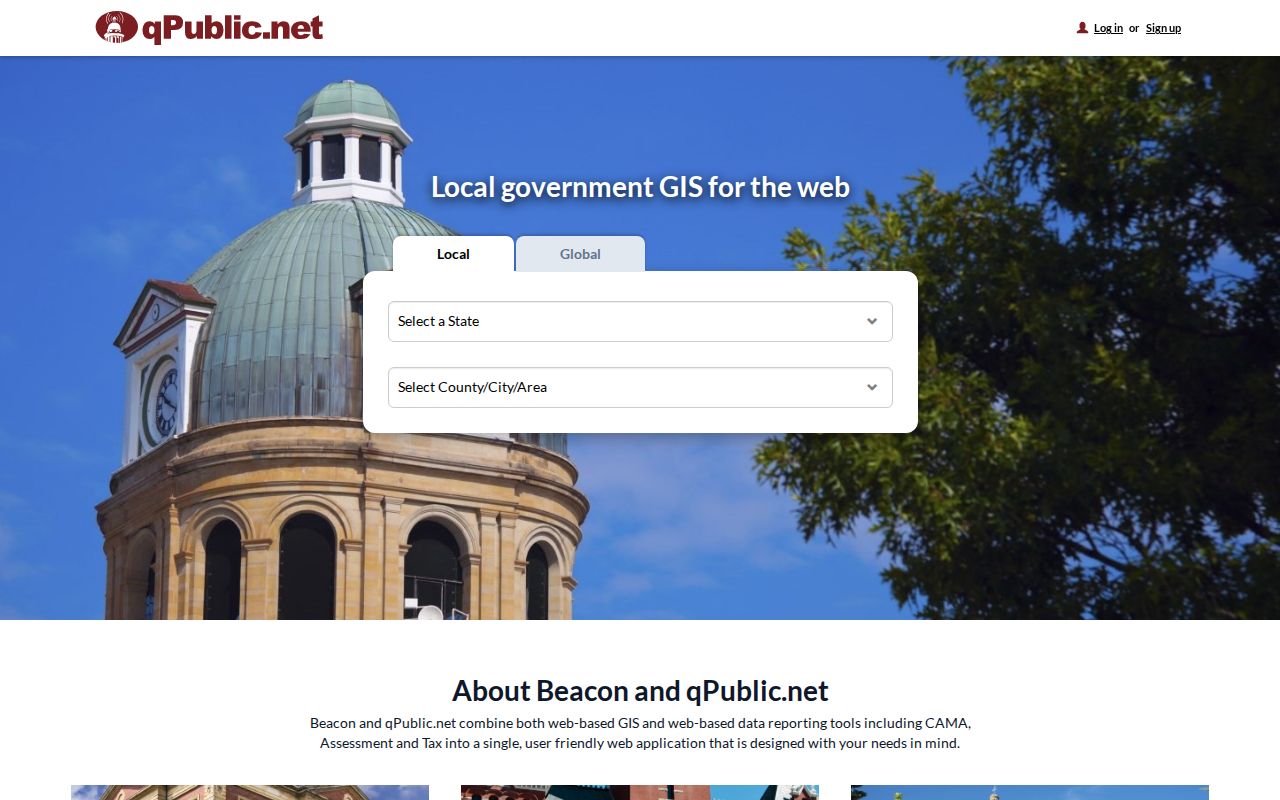
Select Kentucky and Mason County before trusting any result. The vendor's controls do not guarantee that every displayed field is populated on Mason's local record.
When the Mason PVA Page Does Not Load
Online access is only one channel. The Mason County Property Valuation Administrator sits at 220½ Sutton Street, Maysville, KY 41056, and staff answer the phone at 606-564-3700 or email at masonpva@maysvilleky.net. Ask them to pull the assessment record for an address and give you the owner spelling and parcel key you need for the next step of your property search. Bulk map and parcel data requests go through the local PVA as well, since Kentucky Revenue treats a standard map, digital data, and a special project as different things.
The Clerk keeps records available for inspection at 27 West 3rd Street, Maysville. Written requests are supported too, through the Clerk's open-records policy and its OAG-01 request form. Completed original forms travel by mail or hand delivery; the Clerk does not accept them by email or fax.
What a Mason County Property Result May Show
An assessment result and a deed-index result describe different parts of the same parcel. Treat them as two halves. Exact qPublic labels vary on the live screen, so capture the items below if present and reconcile each one against the Clerk's recorded index.
| Owner of record | The name carried on the assessment roll, subject to update lag. |
|---|---|
| Situs and mailing address | The parcel location and the separate address used for owner mail. |
| Parcel identifier | The assessment key used to return to the same tax parcel. |
| Value and tax year | The assessment attached to a stated year, not an asking price. |
| Property characteristics | Land or improvement data if Mason's live card displays it. |
| Deed or sale reference | A clue to verify against the Clerk's index, not proof by itself. |
A parcel card has limits. It proves no surveyed boundary and misses unrecorded interests. A last-sale field can also diverge from the current deed trail, because assessment records and deed records update for different purposes.
Turn the PVA Clue Into an eCCLIX Search
eCCLIX is the Clerk's online route to recorded instruments. It does not generally accept tax-lot or bill-number searches. Carry the exact owner or business name from the PVA and search by party role and date. When the assessment card supplies a book/page or instrument reference, use that more precise key instead.
| eCCLIX field | How to use it | Constraint |
|---|---|---|
| Party name | Search grantor, grantee, or other indexed party | Spelling and entity suffixes matter |
| Book/page | Open a known citation | Usually must come from another source |
| Instrument number | Retrieve a modern filing reference | Not the same as a parcel number |
| Date range | Narrow common names and repeat filings | A range may miss an older link |
The Clerk describes courthouse holdings running from 1795 to the present, with exceptions. Most instrument images sit online from January 2004 forward. An index clue can be visible without payment, though image access may still require an account.
Owner Names Can Hide the Human Story
A Mason County property search can return an LLC, corporation, trust, estate, or multiple owners instead of one person's name. Keep the entity spelling exactly as indexed. The entity name is a clue, not the story. A Kentucky business filing can help identify an LLC or corporation. Probate records may explain a transfer involving an estate. Neither source changes the deed; each only helps interpret the party name before you return to the recorded instrument.
Same-name results demand parcel-level checking. Compare situs, mailing address, parcel identifier, legal-description clues, and dates. Never assume two similar names mean the same person. That caution matters most for rural tracts, which may be described by acreage, roads, creeks, or adjoining owners rather than a modern street address.
Choose Address, Owner, or Parcel for Mason County
Use the narrowest reliable clue. An address reads easily, but it can fail when the mailing city differs from the physical situs or when rural addressing changed. An owner name finds multiple holdings yet invites same-name and entity problems. A parcel identifier is precise within the assessment system. It is not a universal document number.
| Search Key | Best For | Where It Works | Watch Out |
|---|---|---|---|
| Address | One known property | PVA, then land-use map | Situs and mailing city can differ |
| Owner name | Displayed holdings or recorded parties | PVA and eCCLIX | Trusts, LLCs, initials, same names |
| Parcel number | Exact assessment match | PVA and map requests | Not an eCCLIX tax-lot search key |
Not a title search. A Mason County property search assembles public clues but does not guarantee clear title, resolve unrecorded interests, or replace an attorney's or title professional's examination.
Use Mason's Land-Use Map as an Orientation Check
The official Maysville/Mason County Land Use Map displays city limits, community zones, zoning, and the Downtown and Washington historic districts. Those layers explain regulatory geography. Do not count on an ownership popup or adjacency tool here, so get the owner from the PVA and title documents from the Clerk.
A community-zone label is not an incorporated boundary. A zoning class is not a subdivision name. For boundary evidence, compare the map against a recorded plat, a deed description, or a professional survey. The separate Mason County parcel map guide explains that handoff.
The Counter and Archives Extend the Search
Deeds that never made it online still exist on paper. Ask at the Clerk's counter, file a written open-records request, or request a pull from the deed books and microfilm. The Kentucky Department for Libraries and Archives research guides walk through the reverse-chain method. This technique traces each grantor backward as an earlier grantee. For Mason and its neighboring counties, the Kentucky Gateway Museum Center Research Library holds deeds, tax lists, maps, newspapers, and original documents. Staff pull archival items for you. The Mason County Public Library adds its Kentucky Collection and in-house genealogy resources. That gives you another offline route. Whatever you consult, log the collection, volume or reel, page, name searched, legal-description clue, and access date. Then check any transcription or historical reference against the Clerk's recorded book and page. That book and page remains the authoritative source.
Build a Mason Search Workbook From Each Result
Every solid property search rests on identifiers that tie one office to another. Start with the PVA result. Copy the parcel or account number, the owner's name exactly as displayed, the situs address, mailing address, assessment year, property class, and any deed reference or sale field. Labels vary from card to card. Treat the list as a checklist, not a guarantee.
Next, capture what eCCLIX returns. Save the party role, document type, recording date, instrument number or book and page, and image availability. Search the owner as grantee first. That locates the acquisition deed. Run the name again as grantor to catch a later conveyance. Common names call for date filters and a careful comparison of legal descriptions, and entities may be indexed with or without punctuation or a suffix, so preserve the exact form that worked.
Date every entry. Add a source beside each item. An assessment value belongs to a stated year, and a deed index entry to its recording date. Tax status can change. Payment or a transfer to delinquency will move it, and keeping those dates straight prevents a recent deed from being mistaken for an assessment update or a prior-year tax certificate from being read as the current bill.
Conflicts deserve attention. A mailing address may show where the owner receives notices, not where the land sits. A sale field can summarize a transfer without reproducing the deed's legal effect. Parcel keys can change too. A split or combination creates a new key. Note the discrepancy, pull the underlying deed or plat, and ask the right custodian which record controls its own system.
Adapt the Mason Property Search to the Starting Clue
A full street address goes straight into qPublic with the number and street name. If nothing comes back, drop directional prefixes and road-type abbreviations. The mailing city may differ from the physical location. Confirm that before assuming a miss, and ask the PVA about rural address conventions. When a candidate parcel appears, verify it with acreage, nearby roads, owner, and legal-description clues rather than accepting the first similar address.
An owner name alone calls for patience. Joint owners, initials, name changes, estates, trusts, and business entities can each produce a separate index form. Compare parcels one at a time. A Kentucky Secretary of State business filing can clarify which LLC or corporation a deed names, but it does not substitute the company's filing information for the recorded grantee.
A parcel number sends you back to the PVA. Mapping staff can help too. Use the displayed owner or deed citation to enter eCCLIX. Vendor guidance warns that eCCLIX offers no general tax-lot search, and a tax-bill number will not work as a deed-index key. That limitation is why the PVA-to-Clerk bridge matters so much in Mason County.
An old book and page calls for the Clerk. Ask directly or work through the older deed books and reverse indexes. Copy the source-of-title reference from the deed. Follow the grantor backward as an earlier grantee. If the description leans on an old road, creek, farm, or adjoining owner, bring in KDLA guidance, microfilm, Gateway maps, and local newspaper notices for context. Confirm every link against the recorded volume.
A court or estate clue splits into two stops. The Mason Circuit Court Clerk holds the local file. The Clerk's land index leads to the resulting conveyance. Remember that a complaint, probate petition, or sale notice describes a proceeding, not necessarily its final outcome. Locate the judgment, order, commissioner's or fiduciary deed, and the later recording before treating the ownership change as complete.